It is with profoundest humility that I bring you greetings on behalf of the poor, powerless, marginalized, deprived, and traumatized people of Sierra Leone, whom we seek to serve. I also wish to extend my sincere thanks and appreciation to all our previous donors, including Global Humanitarian Funds, MOSS, SDII, GEF, Child Fund International, Action Aid, World Vision International, DFID, UNWOMEN, UNOPS, UNICEF, the UN Peace Building Funds, and UNDP, for their generous grants and technical assistance over the years in various projects and sectors of intervention.
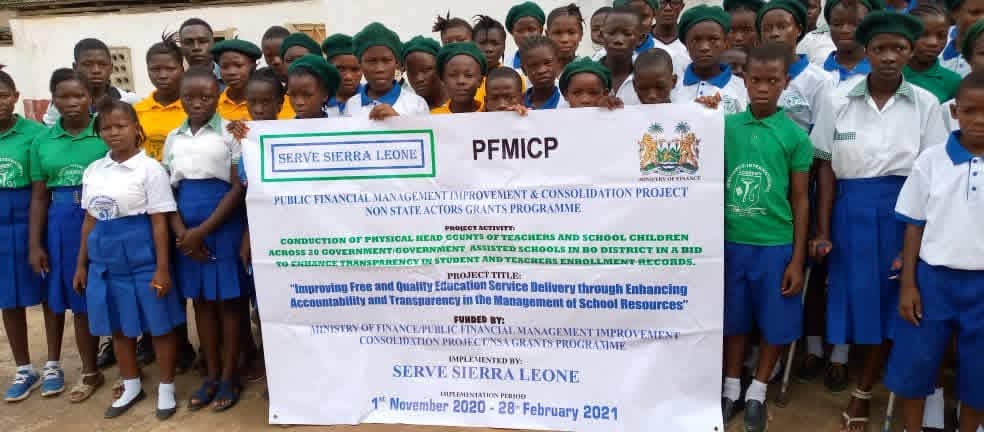
By way of introduction, our entity is called SERVE SIERRA LEONE (abbreviated as SERVE SL), a nonprofit National NGO operating nationwide in Sierra Leone. SERVE SL was established in 2010 as a community-level organization during a critical period when our nation had just emerged from the ashes of a devastating decade-long civil war. These conflicts resulted in the deaths of approximately 250,000 people, displaced and traumatized millions, damaged vital infrastructure and the fragile economy, further exacerbated multi-dimensional poverty and national suffering. Following the end of the civil war in 2002, the country was confronted with the monumental task of building national cohesion, reconstructing decimated infrastructure, reviving shattered governance machinery, fixing the collapsed economy, and rebuilding the social fabric of a deeply traumatized population
Recognizing the urgent need for structured intervention, SERVE SL spent four years as a community-level organization deeply immersed in building networks with community stakeholders and understanding the development gaps and barriers impeding community development, vertically and horizontally. In 2014 SERVE SL was formally incorporated as a national NGO and has over the years delivered impactful and sustainable turnkey projects across different sectors, including but not limited to poverty eradication, climate change mitigation and adaptation, food security, increased access to affordable quality education, safe drinking water, improved primary healthcare services, and clean renewable energy, amongst others.
Beyond the legacy of the civil war, Sierra Leone’s socio-economic development and nation-building efforts are continuously undermined by internal and external shocks inclusive recurring pandemics (the 2014 Ebola outbreak, and COVID-19).Post-pandemic recovery has been hampered existing macro-fiscal vulnerabilities, worsening public debt burden, huge international trade deficits, high inflation and record high currency depreciation. These factors have depressed economic activity, triggering a severe cost-of-living crisis and increasing poverty levels
Although governance has been decentralized since 2004, thousands of communities remain tightly gripped by multi-dimensional poverty. According to the 2025 UNDP Human Development Index and the World Hunger Index, Sierra Leone is ranked 185 out of 193 and 108 out of 123 countries in the world respectively.
This translates to Sierra Leone being the 8th poorest and the 15th hungriest country in the world. Whilst UNFPA 2023 reports show maternal mortality to be 354 per 100,000 live births and child mortality to be 104 per 1,000 live births. Despite all efforts made in the health sector, Sierra Leone still has the highest under-five mortality rate in the world, with 70% of mortality occurring in the age group of 1-59 months. These deaths are mainly from preventable and treatable causes such as malaria, pneumonia, measles, and tetanus due to a lack of access to quality healthcare services (Doctors of the World 2023 report). Also, a 2022 report by the National Institutes of Health places Sierra Leone amongst the top ten countries with the highest rates of teenage pregnancies. The rate stands at 101 per 1000 adolescent girls aged 15 to 19 years, meaning that 21% to 34% of young girls begin childbearing or become pregnant during their teenage years.
The country also suffers from poor adolescent reproductive sexual health indicators, with 40% of maternal deaths in the country occurring amongst teenage pregnant girls. The Sierra Leone health sector is deplorable, and the provision of affordable quality primary healthcare services stands at a crossroads. Additionally, access to safe drinking water is limited; only 23% of households nationwide have access to safe drinking water at their homes, whilst roughly 57% of the 8.7 million people rely on unsafe water sources. Unsafe water is the cause of 30% of the nation’s health issues in the country (MSF/National Health Institute/UNICEF 2023 report). The appalling health situation in the country necessitates more investments to build new health care delivery infrastructure, repurpose old health facilities, and strengthen the health sector through the provision of state-of-the-art machinery, equipment, tools, materials, technology, and well-trained medical personnel with specializations in different medical fields.
Moreover, the 2024 Gender Inequality Index ranks Sierra Leone 157 out of 164 countries, reflecting that socio-economic inequalities of gender are pervasive problem. Prevailing gender and social norms limit opportunities for women and girls, impacting their health, well-being, and progress. An estimated 61% of women aged 15-49 have experienced gender-based violence, but only 40% have reported ever seeking help. In 2021, UNICEF reported that Sierra Leone is home to 800,000 married girls; of this amount, 400,000 were married before the age of 15. Sexual and Gender-Based Violence (SGBV) perpetrated against women and young girls’ remains a public health crisis. The gender inequality gap in education and employment is widening. Gender inequality in education showcases men having a higher literacy rate [56-58%] compared to women [38-41%] as indicated by the 2024 World Bank Development Indicators. The wider gender gap in education is due to the fact that only about 9.5% of women achieve a secondary level education or higher, compared to roughly 20% of men. Whilst inequalities in formal employment space shows women tiny fraction of formal, skilled, and professional jobs, with only 4% in skilled labor and 3% in professional fields (UNDP 2026). The gender inequality gap is worse for women with disabilities, first because they face barriers limiting women’s growth, and second because of low support for women with disabilities.
The Sierra Leone education sector needs total reform, ranging from having gender-responsive education policies and programs to providing affordable and equitable access to quality education. This includes constructing or repurposing new and old schools, providing energy and water in schools, building the capacity of educators with trending teaching skills, and supplying schools with upgraded tools, materials, machines, technology, and innovation that improve teaching and learning outcomes.
Furthermore, Sierra Leone also suffers from a huge energy deficiency, with only 30%-36% of the population in the country having access to electricity. About 55% of urban households have electricity, compared to less than 5% in rural areas. More than 10,000 small and medium enterprises, 5,120 schools, 1,200 peripheral health units, and 5 million people across 1 million households in off-grid communities suffer from energy poverty. The lack of access to sustainable energy in off-grid communities is a limiting factor affecting enterprise development, constraining manufacturing and production, hampering the full functioning of schools, hospitals, and technical vocational institutes, threatening food security, and lowering the standard of living.
However, Sierra Leone is the third most vulnerable country to climate impacts. Climate change problems in Sierra Leone have affected all sectors and still pose a threat to reverse gains made in education, agriculture and food security, energy and water supply, health and sanitation, disaster management and peace-building, production and manufacturing, trade, industry and commerce, human security, and infrastructural development. Climate change is now more of an emergency than a problem and a crisis to sustainable development.
Lastly, and more importantly, despite our laudable past achievements and despite the factor that we are a pivotal player in the NGO sector, with highly experienced board and dedicated management known for delivering impactful and sustainable interventions in an accountable and transparent manner. We are equally faced with the undeniable fact that Sierra Leone’s economic recovery and development stand at a crossroads, the road ahead is tough and difficult, with many unsolved development gaps competing with emerging challenges in a resource constrained environment. Consequently, SERVE SL alone cannot shoulder these immense responsibilities alone. We therefore, earnestly and urgently appeal to donor organizations, philanthropic groups, family foundations, people of good will, and development partners to support our work by providing grants (cash and in-kind), technical assistance, and capacity building. This support will enable us to deliver interventions tailored to the urgent needs of the targeted beneficiary communities. The time to invest in the economic recovery and sustainable development future of Sierra Leone and its people is now, , and there could be no better time than.
1Kallon Drive,Mendewa Section, Bo City, Kakua Chiefdom, Bo District. | Phone: +23278241319 | Email: admin@servesierraleone.org
Designed by Lumigrow Marketing Solutions
No WhatsApp Number Found!
WhatsApp us
